


Blogs Categories
Don't Replace Your Diesel Generators: Upgrade with RECD to Meet India's Emission Standards
A Retrofit Emission Control Device (RECD) is designed to be installed on existing diesel generators to significantly reduce particulate matter (PM) and harmful gases like HC, CO and NOx emissions from the exhaust. Instead of replacing existing gensets and investing in a completely new generator, businesses can retrofit their existing equipment, improve environmental compliance, and continue using assets that still have years of operational life remaining.
Whether you operate a manufacturing facility, hospital, commercial building, warehouse, educational institution, or infrastructure project, using an RECD Kit for DG Set offers an efficient path toward cleaner operation with minimal interruption to your business.
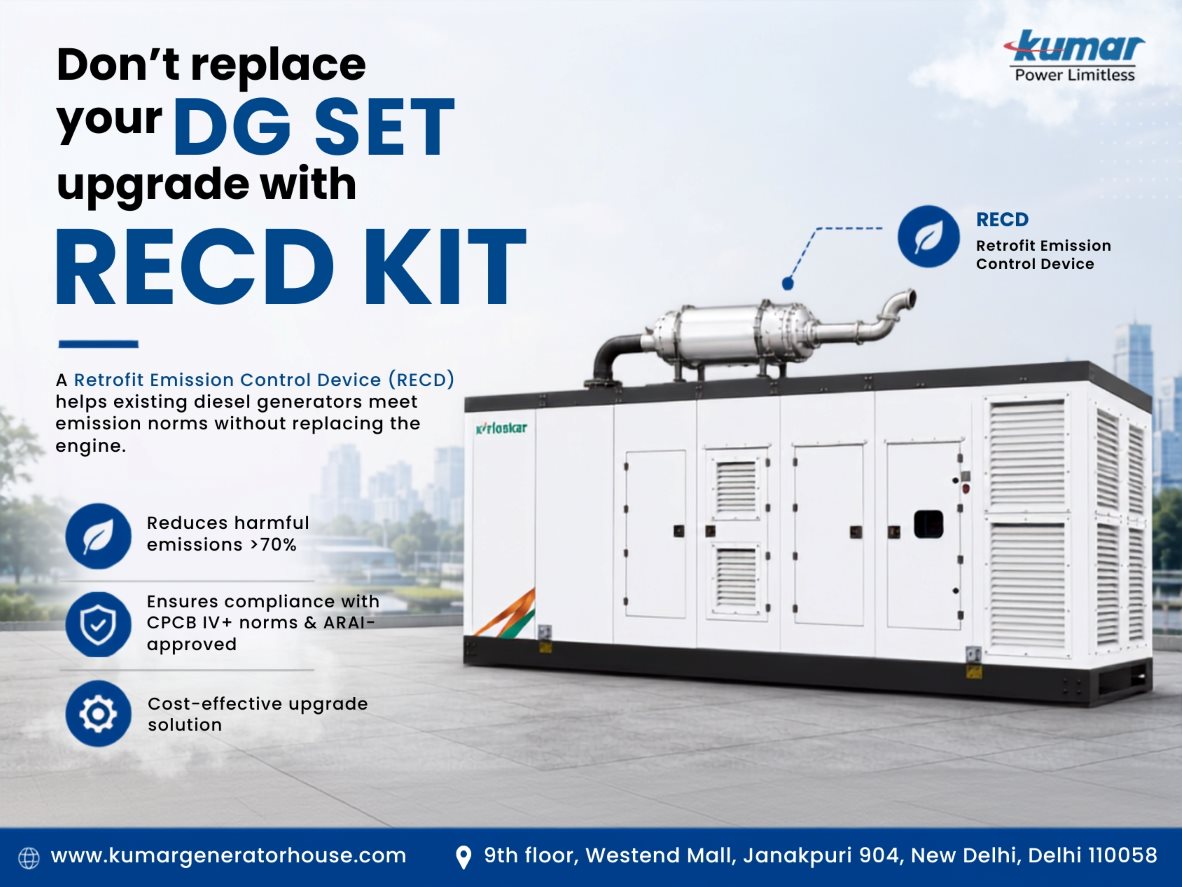
India's approach to diesel generator emissions has changed significantly in recent years. The significant increase in air pollution has become a major concern for the government. The Central Pollution Control Board and CAQM have set strict rules and regulations for diesel generators of more than 125 kVA. The government is imposing heavy fines on businesses that fail to comply with these regulations. Along with the ban on generators, these businesses could even face shutdowns.
With stricter environmental regulations, increased inspections, and greater focus on air quality, industries operating older diesel generators are under pressure to reduce emissions without disrupting business operations.
For many organizations, replacing an existing generator is not an immediate option. A functioning generator may still be mechanically sound, yet fail to meet today's emission expectations. This is where an RECD Kit becomes a practical and future-focused solution.
Why Are RECD Kits Becoming Essential in India?
Across India, environmental compliance is no longer viewed as an optional improvement. It has become an operational responsibility. Industries today frequently undergo: Pollution Control Board inspections Environmental audits Factory compliance assessments Client sustainability evaluations Government project inspections ESG and environmental reporting
Organisations working on government tenders, construction projects, industrial manufacturing, pharmaceuticals, logistics, hospitality, and commercial infrastructure are increasingly expected to demonstrate responsible emission control practices.
Many facilities continue to rely on older diesel generators because they remain reliable during power outages. However, these legacy generators generally emit higher levels of particulate matter than modern systems.
Choosing the practical solution is better than changing the entire genset
Replacing an entire diesel generator often requires major planning, approvals, transportation, civil work, and production downtime. The diesel generator may be old, but it can still function effectively for the next 10 to 15 years. Moreover, the cost of purchasing a new generator is many times higher than upgrading an old one through retrofitting.
In such a scenario, replacing it, especially when a practical solution like RECD is available, is not a wise decision for industries. For many businesses, retrofitting an RECD kit provides a practical alternative that helps reduce emissions while extending the service life of existing equipment.
Why Replacing an Old Generator Isn't Practical?
When emission regulations become stricter, the first thought is often, "Should we replace the generator?" In reality, replacing a diesel generator involves far more than purchasing new equipment. Businesses may also need to consider:
For facilities that depend on continuous power backup, these challenges can directly affect productivity and project timelines. Where the existing generator remains mechanically healthy, installing an RECD kit can often be a more practical and less disruptive approach to improving emission performance.
How Does an RECD Kit Work?
Although the technology inside an RECD is advanced, its working principle is straightforward. RECD fit inside the diesel generator with connected to its exhaust. RECD stands for Retrofit Emission Control Device. The retrofit device not only reduces the PM but is also effective in controlling harmful compounds like CO, HC and NOx.
Step 1
Step 2
Step 3
Step 4
Step 5
The RECD features a special honeycomb-like structure and a coating of costly metals that safely converts toxic gases into air. Without generating any other harmful waste. It is not an ordinary mesh but a high-tech chemical and mechanical converter.
As exhaust gases pass through the RECD, harmful particulate matter is trapped within the filtration system. Depending on the design, the collected particles are periodically removed through a controlled regeneration process that restores filtration efficiency.
Electrical Working of an RECD System
One of the most overlooked aspects of an RECD is its intelligent electrical control system. A modern RECD is not merely a filter attached to the exhaust. It continuously monitors operating conditions to ensure reliable performance. Typical electrical components include:
The Central Pollution Control Board has set strict rules regardless of pollution. With the help of stations, they keep monitoring and analysing data collection.
- Intelligent Control Panel: The control panel acts as the central monitoring unit, supervising the operating condition of the RECD and displaying system status.
- Temperature Sensors: Sensors monitor exhaust temperatures to ensure the system operates within the required thermal range and to support regeneration when necessary
- Pressure Sensors: Pressure sensors measure the pressure difference across the filtration system. A gradual increase indicates soot accumulation and helps determine when regeneration or maintenance is required.
- Automatic Regeneration Cycle: When operating conditions permit, the RECD performs controlled regeneration to remove accumulated particulate matter and restore filtration performance.
- Continuous Monitoring: The system continuously checks temperature, pressure, and operational status, helping maintain efficient emission control throughout generator operation.
- Safety Alarms: Modern RECD systems include alarms and protective functions that notify operators if abnormal operating conditions are detected.
- Power Supply: The electrical control unit receives power from the generator system, allowing continuous monitoring whenever the generator is running.
Together, these components help ensure that the RECD operates efficiently without requiring constant manual supervision.
The RECD Kits Kumar Generator House Supply
Kumar Generator House is an auhtorized supplies of Kirloskar Generators, as well as an ISO 9001:2015 certified company. The RECD kits we supply are designed to help organisations retrofit existing diesel generators while maintaining dependable operation. While new diesel generators are already manufactured in compliance with CPCB IV+ norms, existing industries operating older CPCB II-compliant generators can upgrade them using tailored retrofit kits designed specifically for their generator models.
Why Kumar Generator House
- Up to 90% Particulate Matter (PM) reduction to seamlessly meet strict CPCB IV+ compliance norms.
- 100% reliable automated regeneration process ensuring zero manual intervention and continuous peak performance.
- Custom-engineered for older generator models to ensure a flawless and secure retrofit installation.
- Heavy-duty industrial-grade construction tested to operate efficiently in extreme environments up to 50°C.
- Intelligent IoT monitoring system tracking emissions and generator health metrics with 99.9% data accuracy.
- Less than 6-hour quick installation time causes minimal disruption to your daily factory operations.
- 5-step easy inspection design reducing your annual maintenance time by over 40%.
- Zero-cost technical consultation and site assessment are conducted before final deployment.
- Pan-India network across 25+ states ensures rapid component supply and immediate on-ground support.
- 24/7 expert installation guidance backed by a dedicated after-sales technical assistance team.
Every installation begins with a technical evaluation to ensure the selected RECD is suitable for the generator and application.
Compatible Diesel Generator Brands
RECD compatibility depends on several technical factors, including:
- Generator capacity
- Engine manufacturer
- Engine model
- Exhaust configuration
- Operating conditions
- Year of manufacture
- Generator duty cycle
- Daily operating hours
- Available installation space
Following technical assessment, RECD kits can be integrated with generators from many leading manufacturers, including:
Compatibility should always be confirmed through an engineering inspection rather than generator capacity alone.
Industries That Benefit from RECD Installation
RECD kits are suitable for a wide range of sectors that depend on diesel generators for backup or continuous power.
Any organization operating legacy diesel generators while seeking cleaner emissions can benefit from retrofit emission control solutions.