


Blogs Categories
What to Consider Before Buying a Kirloskar Gas Generator
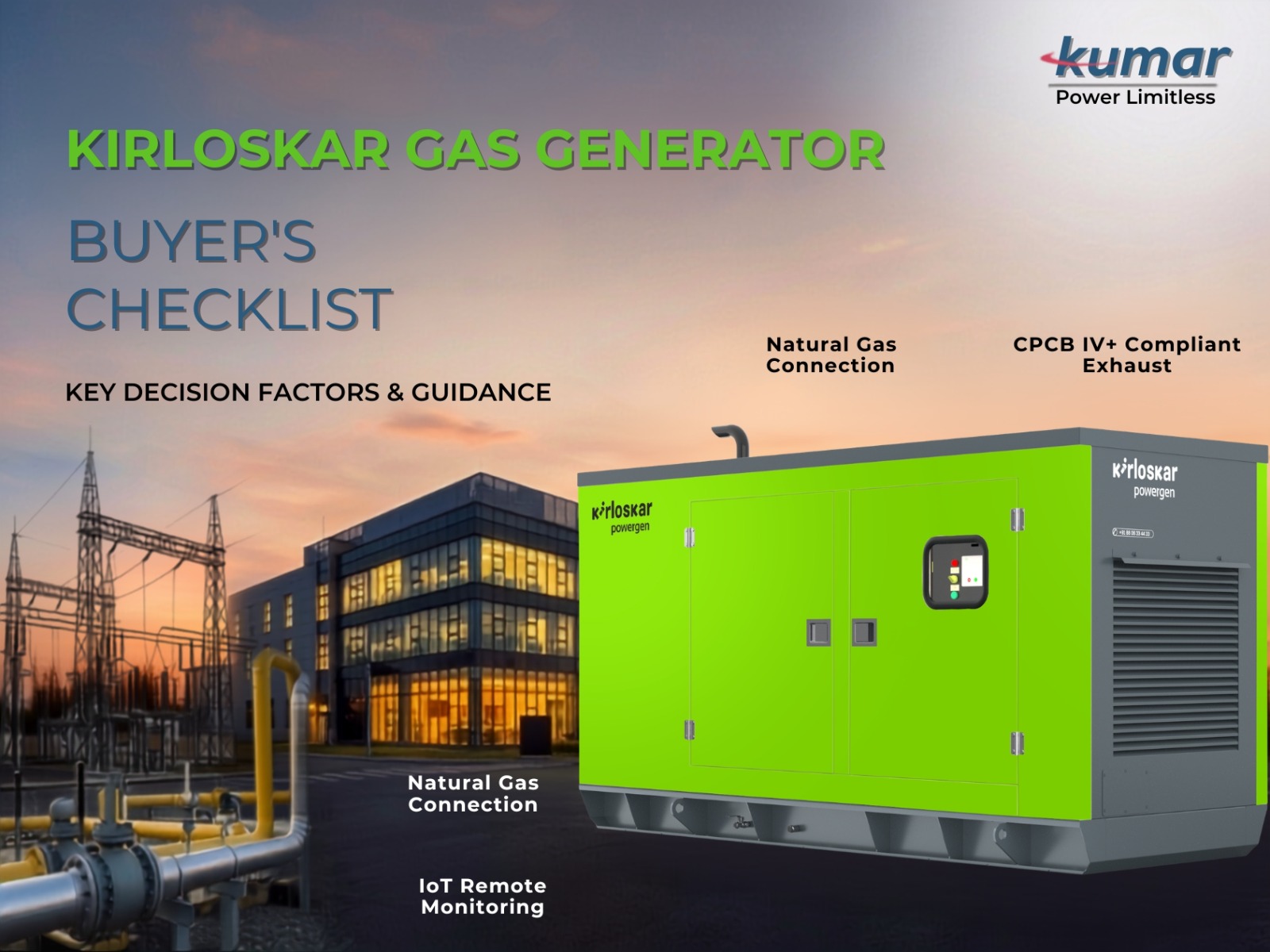
Planning to buy a Kirloskar gas generator? Explore key factors like power capacity, fuel type, CPCB IV+ compliance, and after-sales support before you invest.
A reliable power backup solution is no longer a luxury—it is an operational necessity for homes, commercial establishments, and industries alike. Among top-tier manufacturers, Kirloskar (KOEL) stands out for producing durable, fuel-efficient, and eco-friendly gas gensets.
If you are evaluating a Kirloskar gas generator for your facility, here are the essential factors to review before investing.
1. Calculate Your Exact Load Requirement
List Your Equipment: Calculate the total wattage of all essential appliances, machinery, and non-linear loads (like IT equipment or VFDs).
Right-Sizing: Kirloskar offers gas generators ranging from compact 15 kVA units up to 250 kVA industrial-grade systems. Sizing accurately prevents engine overloading or wasted fuel expense on an oversized generator.
2. Verify Available Gas Fuel Sources
PNG (Piped Natural Gas): Highly economical and continuous for locations with direct grid connection.
LPG & Biogas Options: Provide operational flexibility for sites reliant on independent supply cylinders or alternative gas feeds.
3. Evaluate Operating Efficiency & IoT Features
Fuel Consumption: Gas generators generally yield lower operational costs than diesel counterparts. Check the model's fuel burn rate at 50%, 75%, and 100% load capacities.
Smart Monitoring: Modern Kirloskar gas gensets feature integrated remote monitoring systems, allowing real-time tracking of performance, temperature, and maintenance status via mobile or desktop.
4. Check Noise Limits and CPCB Norms
Acoustic Enclosures: For residential complexes, offices, or healthcare facilities, choose silent canopy models designed to operate below target decibel levels.
CPCB IV+ Compliance: Ensure the model adheres to the latest CPCB IV+ emission standards, incorporating catalytic converters to minimize particulate matter and exhaust emissions.
5. Assess Installation Footprint & Start Automation
Space & Ventilation: Factor in adequate clearance for exhaust piping, ventilation airflow, and technician access.
AMF Panel (Auto-Start): For critical environments where downtime is unacceptable (e.g., hospitals, data centers), opt for an Automatic Mains Failure (AMF) panel that engages power seamlessly during grid cuts.
6. Review Service Network and Total Cost of Ownership (TCO)
After-Sales Support: Kirloskar's extensive service and dealer network ensures fast access to genuine spare parts and technician support.
Lifetime Value: Beyond the upfront purchase price, factor in installation costs, gas tariff rates, and preventative maintenance cycles over the generator's operating lifespan.
Frequently Asked Questions
1. What types of fuel can a Kirloskar gas generator run on?
Kirloskar gas generators are engineered to run on Piped Natural Gas (PNG), Liquefied Petroleum Gas (LPG), and Biogas, depending on the specific model configuration.
2. How are Kirloskar gas generators better than traditional diesel generators?
Gas generators offer significantly lower fuel running costs, produce less carbon particulate matter, operate more quietly, and comply strictly with clean CPCB IV+ environmental norms.
3. Can a Kirloskar gas generator turn on automatically during a power cut?
Yes. When integrated with an Automatic Mains Failure (AMF) control panel, the generator automatically detects a grid failure, starts up, and transfers the load within seconds.
4. What capacity range is available for Kirloskar gas generators?
Kirloskar gas gensets are available across a wide spectrum, starting from small 15 kVA commercial/residential units up to 250 kVA industrial configurations.
5. What regular maintenance does a gas generator require?
Routine service involves inspecting gas supply lines, spark plugs, air filters, engine oil levels, battery health, and verifying the catalytic converter's operational condition.